The Ringing In Your Ears Is Not
Coming From Your Ears
Millions of Americans — including veterans and industrial workers — are told to "learn to live with it." What neurologists discovered about the real cause of that sound changes everything your doctor may not know yet.
Don't scroll past this: If you've been dismissed by a doctor, failed with supplements, or had a claim denied — the next 3 sections may explain exactly why nothing has worked yet.
You've Already Tried.
Nothing Worked. Here's the Real Reason.
You wake up at 3 AM again. The room is completely silent — but inside your skull, something is screaming.
It's been months. Maybe years. You've seen the ENT. He ran tests, looked in your ears, and came back with that phrase you've heard too many times: "Everything looks normal. You'll have to learn to live with it."
You nodded. Said thank you. Drove home in silence — or what passes for silence when there's a constant chainsaw sound running permanently in your head.
Maybe you've tried a hearing aid. White noise machines. A supplement from Amazon. Maybe you've even filed a claim, only to have it denied or walked back months later. Every morning, the sound is still there. Every night, it gets worse.
What the ENT didn't tell you — and likely doesn't know — is that the ringing isn't being generated by your ear at all.
It's being generated by your brain. Specifically, by a malfunction in the neural pathway that connects your auditory nerve to your cerebral cortex — a pathway that, once it starts misfiring, your ear canal has absolutely zero ability to fix.
That's why every ear drop, every hearing aid, every masking device has failed you. You've been treating the wrong organ.
You're not imagining it. You're not weak. You're not someone who just needs to "accept" the situation. You're someone who's been given the wrong explanation — and therefore the wrong solutions.
And the moment that changes, everything else can change with it.
So What Does Cause
the Ringing? Here's the Mechanism.
Understanding what causes tinnitus properly — not the simplified version your doctor gave you — is the first step to understanding why most treatments fail.
Think of your auditory nervous system like a cable running from your inner ear to your brain's processing center. In most people, that cable is insulated. Sound enters. Signal travels. Your brain interprets it. Clean.
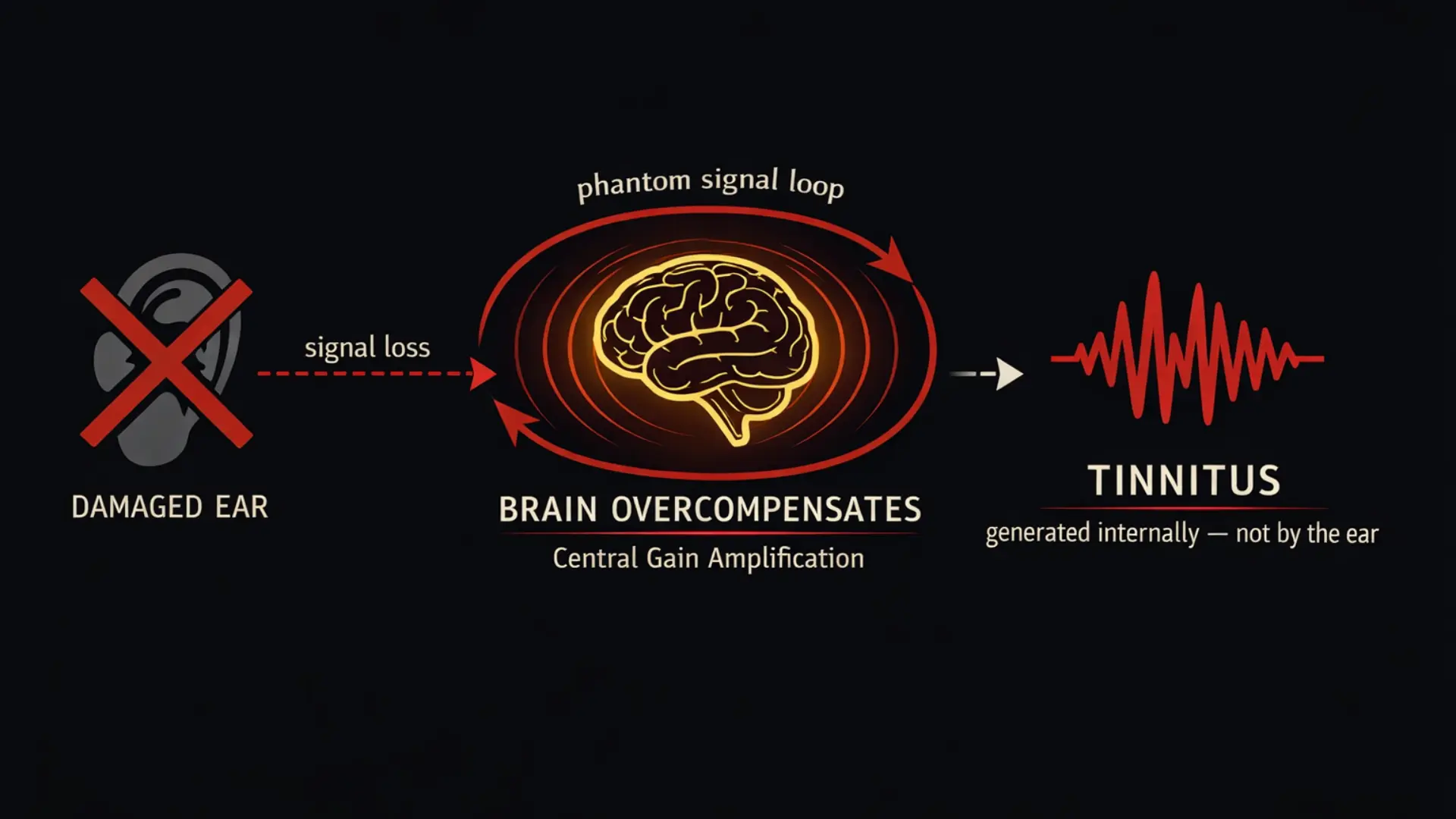
But in people with chronic tinnitus, something has disrupted that insulation. The signal leaks. The brain picks up interference — a phantom frequency it generates itself in a desperate attempt to fill what it perceives as silence.
Why Your Brain Creates Noise
That Doesn't Exist Outside Your Head
When auditory hair cells in the cochlea are damaged — through noise exposure (military service, industrial work, machinery, concerts), aging, or certain medications — they stop sending their normal signals.
Your brain, starved of expected input, compensates by increasing its own neural gain: essentially turning up its own volume to "hear" what's missing. The result is called central gain amplification.
The ringing you hear is your own central nervous system misfiring — stuck in an ON loop, broadcasting a signal with no external source. No hearing aid can fix a broken central gain mechanism. No ear drops reach the cochlear nucleus. No masking device tells your brain to stop generating the signal. They only cover it up — temporarily — until the moment of silence returns.
And silence always returns. At 3 AM. In the car with the engine off. At the dinner table when you just want a quiet conversation.
Why the Usual Approaches Don't Address This
| Approach | ❌ Why It Falls Short | ✅ What Would Help Instead |
|---|---|---|
| Hearing Aids | Amplifies external sound — doesn't address the internal signal generation | Approaches that target central neural activity, not peripheral hearing |
| White Noise / Masking | Covers the sound temporarily — brain resumes generating it the moment masking stops | Interrupting the neural loop at the source, not at the surface |
| Most Supplements | Formulated for peripheral ear health — doesn't reach the cochlear nucleus or auditory cortex | Targeting the neurological component with documented mechanism of action |
| Standard CBT | Helps manage distress — but doesn't change the neural signal itself | Combined approaches that address both the signal and the stress feedback loop |
This isn't about blaming the medical system. Most general practitioners and even many ENTs are simply trained in peripheral audiology — the ear itself. The neurological component of chronic tinnitus is a relatively recent area of research, and it hasn't yet reached most clinical protocols.
That's not their fault. But it does mean the answer to how to stop ringing in your ears may not come from where you've been looking.
The Night He Almost Stopped Fighting
Mike hadn't slept more than four hours straight in three years. His wife, Carol, had started sleeping in the guest room — not because she wanted to, but because watching him lie awake staring at the ceiling was breaking her heart.
"I'd lie there doing the math," he told us. "I'm 61. If I live to 80, that's 19 more years of this sound. Every single night. I didn't want to think past that."
He'd done what the system told him. Hearing aids. White noise machines. He'd tried the $89 supplement that promised "neural restoration" and did nothing. He'd even downloaded a frequency generator app and spent two weeks trying to find the tone that might cancel his out.
"The doctor said I needed to accept it. Acceptance. Like this was something I chose. Like I wasn't a completely different person before the noise started."
What Mike didn't know — what nobody had explained to him — was that the mechanism generating his tinnitus had changed over the years. What started as peripheral damage from working next to industrial machinery had evolved into a central nervous system pattern. His brain had been running the same broken loop for so long it had essentially learned the sound.
The ringing wasn't just noise anymore. It was a neural habit. And habits — even terrible, involuntary ones — can be interrupted.
"The first morning I woke up and the sound wasn't the first thing I noticed — I just laid there for a full minute before I realized something was different. Carol was already up. I went downstairs and she looked at me and said: 'You're back.'"
— Mike R., 61, Phoenix AZ · 14 years of chronic tinnitusIs Your Brain Running the Same Broken Loop?
Tinnitus is not a single condition — it's a spectrum. When these symptoms appear together, they suggest a centralized neural pattern rather than simple peripheral hearing loss. Check how many apply to you:
If you identified with 4 or more of the above, your tinnitus has
likely crossed from a peripheral ear issue into a centralized neural pattern —
the kind that conventional ENT treatment is not designed to address.
This distinction is not academic. It determines whether what you're
doing is even capable of helping.
If you matched 4 or more symptoms above,
there's a specific reason why nothing has worked.
A free 8-minute presentation explains the neurological mechanism — and what approaches actually address it, according to documented research.
Show Me What's Actually Happening →He Didn't Want to Post This.
He Did It Anyway.
The following was shared publicly on Reddit's r/tinnitus community. We include it because it reflects a pattern that appears consistently — and because it deserves to be read by people in the same situation.
"I've been a tinnitus-haver for over 14 years.
Spent money on hearing aids, sound machines, supplements,
apps, and more doctor visits than I can count. Every time
I'd find something that gave me hope, it'd wear off in a week
or just never work at all.
What I didn't understand — and nobody told me — is that after
years of that loop, your brain isn't just processing a damaged signal.
It's memorized it. That's a completely different problem than a
broken eardrum, and it needs to be treated differently.
I'm not going to say I'm cured. But the last two weeks have been the
quietest of the last decade. My wife mentioned it before I did.
I didn't want to get her hopes up. First time I've eaten dinner
without the TV on to drown out the noise. First time in years."
Across forums like r/tinnitus and r/TinnitusTalk, the same pattern appears: people who failed conventional treatment for years finding partial or significant relief once they understood — and addressed — the neurological component.
It doesn't always happen quickly. It doesn't always happen completely. But the difference between people who see change and those who don't usually comes down to one thing: whether they were targeting the right mechanism.
What the Research Actually Shows
You've been told tinnitus has no cure. That's partially accurate — there is no single FDA-approved pharmaceutical that eliminates tinnitus. But the research on tinnitus natural treatment alternatives and neurological approaches is considerably more advanced than most general practitioners know.
The cycle is well-documented: poor sleep → heightened neural sensitivity → louder perceived tinnitus → worse sleep → repeat. Breaking one link in that chain consistently disrupts the others.
This is why the most effective emerging approaches don't focus on the ear. They focus on the brain's auditory processing system — the part that generates, amplifies, and perpetuates the signal your ear stopped producing years ago.
The research is documented.
The mechanism is understood.
A free presentation covers the neurological evidence in detail — and what specific approaches researchers have studied to interrupt the loop.
Watch the Free Presentation →What People Ask When They're Finally Ready
Source: Mayo Clinic · mayoclinic.org/diseases-conditions/tinnitus | PMC6910025
You've Spent Years Managing the Sound.
It's Time to Address the Source.
The research is documented. The mechanism is understood. The question is whether you take the next step — or spend another year waiting for your doctor to catch up.
Watch the Free Presentation →